
CARPAL TUNNEL SYNDROME
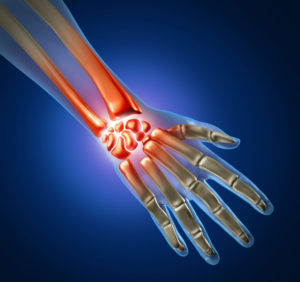 Wondering if You have Carpal Tunnel Syndrome or a Pinched Nerve?
Do you ever have sensations like tingling or numbing in your hand, thumb, index, middle or ring finger? Do you ever feel pain down into your hand or shooting up your arm towards your neck? How about a weak feeling in your hands? Does it come on after activities such as typing, driving, or answering phones and wake you up in the middle of the night? If so, you may have carpal tunnel syndrome and we are confident we may be able to help!
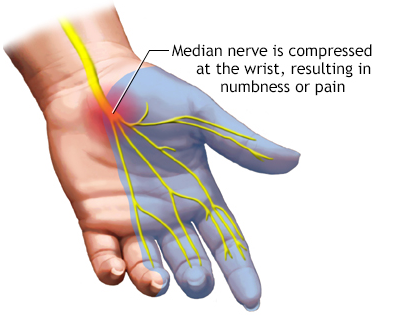
There is a nerve called the median nerve which runs from your lower cervical spine down to the first four fingers in your hand, not the fifth. At the wrist, the nerve goes between a large ligament and your carpal bones or wrist bones. Sometimes with repetitive motion activities the ligament can become inflamed and there could be a misalignment of your carpal bones. When this happens, compression of the median nerve occurs and causes the symptoms previously described above. Adjustments to the hand and wrist as well as some natural anti-inflammatory therapies can help to decrease the symptoms in carpal tunnel syndrome and possibly cause them to go away all together.

A business man holding his hands because of pain while working on a laptop.
Carpal Tunnel Syndrome
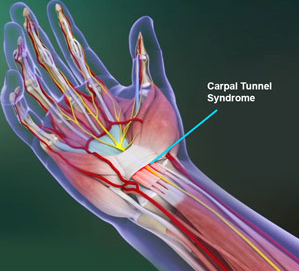
Can occur when the median nerve, which runs from the forearm into the hand, becomes pressed or squeezed at the wrist. The carpal tunnel – a narrow, rigid passageway of ligament and bones at the base of the hand houses the median nerve and tendons.
Sometimes, thickening from irritated tendons or other swelling narrows the tunnel and causes the median nerve to be compressed. Results may be pain, weakness, or numbness in the hand and wrist, radiating up the arm. Although painful sensations may indicate other conditions, carpal tunnel syndrome is the most common and widely known of the entrapment neuropathies in which the body’s peripheral nerves are compressed or traumatized.
Symptoms usually start gradually, with frequent burning, tingling, or itching numbness in the palm of the hand and the fingers, especially the thumb and the index and middle fingers. Some carpal tunnel sufferers say their fingers feel useless and swollen, even though little or no swelling is apparent. The symptoms often first appear in one or both hands during the night, since many people sleep with flexed wrists. A person with carpal tunnel syndrome may wake up feeling the need to “shake out” the hand or wrist. As symptoms worsen, people might feel tingling during the day. Decreased grip strength may make it difficult to form a fist, grasp small objects, or perform other manual tasks. In chronic and/or untreated cases, the muscles at the base of the thumb may waste away. Some people are unable to tell between hot and cold by touch. Carpal tunnel treatment should be as conservative and as noninvasive as possible.
Acupuncture, Chiropractic and certain Physiotherapies such as class IV Cold Laser and muscle stimulation can achieve excellent results with carpal tunnel. Not sure what is the right treatment for you? No worries that is exactly why we have a team of multiple practitioners with multiple areas of expertise who will work together as a team to get you well! ~That’s What We Do!
Schedule an Appointment – We are here to help you!
Overland Park, KS Clinic
6701 W. 121st Street | Suite 200
Overland Park, KS 66209
913-643-1771
913-643-1775
Olathe, KS Clinic
10454 S. Ridgeview Rd.
Olathe, KS 66061
913-689-2333
913-689-2334
Prairie Village, KS Clinic
4121 W. 83rd St. | Suite 147
Prairie Village, KS 66208
913-490-4444
913-490-4445
Raytown, MO Clinic
10803 E State Rte 350 | Suite B
Raytown MO 64138
816-356-9313
816-831-3601
Lee's Summit, MO Clinic
338 Southwest Main St.
Lee's Summit, MO 64063
816-600-5483
816-524-5328
Belton/Raymore, MO Clinic
17027 Bel-Ray Blvd.
Belton, MO 64012
816-425-7015
816-425-2117
Blue Springs, MO Clinic
622 SW US 40 Hwy
Blue Springs, MO 64014
816-815-7007
816-815-7008
Liberty, MO Clinic
1520 N. Church Rd | Suite C
Liberty, MO 64068
816-831-3600
816-831-3601
N. Kansas City, MO Clinic

Be a Wellness Warrior!
Stay informed with ASFCA wellness news, upcoming events & patient appreciation specials.

Top Rated Clinics

ASFCA on Facebook

Advanced Sports & Family Chiropractic & Acupuncture
(opens in a new tab)We are a team of dedicated doctors and staff whose mission is to get you to wellness! Give us a call to start your health care journey!
Big exciting news coming in just one month!
Opening Monday, November 30th!
Accepting New patients NOW for our new Northland location - call (816) 552-0959
8630 North Greenhill Rd. 
Suite 100
Kansas City, MO 64154
0 CommentsComment on Facebook
Your chiropractor is the best trained professional to take care of your spine safely and effectively!
0 CommentsComment on Facebook
