ROTATOR CUFF & SHOULDER PAIN
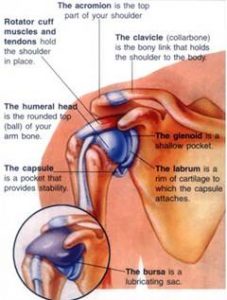 The shoulder is comprised of several joints that are held together with tendons and muscles. The shoulder joint made up of the glenoid fosse and the humeral head form a ball and socket joint. This type of joint allows for great range of motion. With increased joint motion less, stability is present. To help stabilize the joint during these large movements the shoulder had many muscles and ligaments that provide support to maintain the joint position. Most shoulder injuries are due to damages acquired by the soft tissue. Most shoulder problems can be categorized into three major categories:
Tendonitis
A tendon is the soft tissue structure that connects muscle to bone. When a tendon is irritated is can become inflamed and this is called Tendonitis. The overuse of the shoulder or improper technique when performing repetitive activates are just two ways that the tendons over time can become inflamed. Tendonitis over time can alter the motion of the joint leading to extreme wear on the soft tissues and eventually the tendon can begin to tear. When a tear is present in the 4 most prominent muscles of the shoulder it is referred to as a rotator cuff tear.
Bursitis
A bursa is a fluid filled sac that allows for easy movement of the muscles and ligaments over bone. When the bursa becomes inflamed it is called Bursitis. Bursitis is often the result of excessive use of the shoulder. Bursitis can be very painful and can be debilitating. When the condition advances to the point that the joint is unable to function, the resulting condition is called frozen shoulder.
Injury/Instability
As we look at the should joint structure what we know is that it allows for a lot of motion but little stability. This allows the joint to be more susceptible to dislocation. This is usually the result of a great trauma that compromised the soft tissue structures or a combination of micro traumas that left the shoulders stabilizing structures week allowing for instability of the joint to overtake the stability of the joint. When not corrected, it can lead to reoccurring dislocations and further damage in the future of the soft tissue structures. Our team is trained to evaluated and rehabilitate you shoulder to prevent or reduce the frequency of future dislocations.
Arthritis
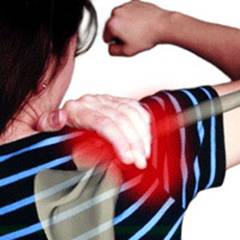
Over time these various injuries and micro traumas that lead to inflammation and irritation of the shoulder joint can lead to arthritis. Arthritis can lead to pain and swelling that can affect motion and quality of life. When the arthritis becomes sever enough it can cause bone spurs that can rub on the tendons and muscle of the shoulder resulting in rotator cuff tears down the road. When arthritis sets in it can cause shoulder pain that makes the patient avoid motion and leads to the joint stiffening up and eventually will no longer function.
Treatment
With the shoulder joint it is important to not ignore even minor pain. Pain is an indication that there is a problem and when ignored a small easy to treat problem can latter become a much bigger issue. A Chiropractor can evaluate your shoulder and help to restore normal function and reduce inflammation with the use of Chiropractic manipulation and the use of rehabilitative exercises that will help to put the shoulder joint back in balance. Inflammatory conditions respond well to Acupuncture as well as Cold Level Laser.
Schedule an Appointment – We are here to help you!
Overland Park, KS Clinic
6701 W. 121st Street | Suite 200
Overland Park, KS 66209
913-643-1771
913-643-1775
Olathe, KS Clinic
10454 S. Ridgeview Rd.
Olathe, KS 66061
913-689-2333
913-689-2334
Prairie Village, KS Clinic
4121 W. 83rd St. | Suite 147
Prairie Village, KS 66208
913-490-4444
913-490-4445
Raytown, MO Clinic
10803 E State Rte 350 | Suite B
Raytown MO 64138
816-356-9313
816-831-3601
Lee's Summit, MO Clinic
338 Southwest Main St.
Lee's Summit, MO 64063
816-600-5483
816-524-5328
Belton/Raymore, MO Clinic
17027 Bel-Ray Blvd.
Belton, MO 64012
816-425-7015
816-425-2117
Blue Springs, MO Clinic
622 SW US 40 Hwy
Blue Springs, MO 64014
816-815-7007
816-815-7008
Liberty, MO Clinic
1520 N. Church Rd | Suite C
Liberty, MO 64068
816-831-3600
816-831-3601

Be a Wellness Warrior!
Stay informed with ASFCA wellness news, upcoming events & patient appreciation specials.

Top Rated Clinics

ASFCA on Facebook

Advanced Sports & Family Chiropractic & Acupuncture
(opens in a new tab)We are a team of dedicated doctors and staff whose mission is to get you to wellness! Give us a call to start your health care journey!
Your reminder that processed foods with high sugar are terrible for your entire body, including your heart. Make it a habit to avoid high sugar foods / drinks and your body will thank you!
0 CommentsComment on Facebook
Setbacks are bound to happen when you are trying to achieve difficult goals, don't let temporary defeat dampen your spirit - keep going!
1 CommentsComment on Facebook